Saturday, June 20, 2009

Garden Patrol-- Jackie's Garden

I’ve been helping neighbor Dave with his fight against the creeping charlie that has invaded his lawn. We really knocked it hard a few weeks ago with the Weed Beater Ultra but it looks like we will have to hit it again before we reseed but with the weather we’ve had to take a break. So while we wait how bout another installment of Garden Patrol?

My daughter Alexa showed me this garden one day when we were out on our bikes. It belongs to the grandmother of one of her friends. What intrigued me about this garden is its complete lack of lawn area. I don’t know how well this concept would translate on a large country lot but it is fabulous on a smaller city lot. I absolutely loved the creeping jenny (lysimachia nummularia) “walkway.” You may have seen this plant used as the “spiller” or vining plant in a container, but it actually is winter hardy in our area. It takes sun or shade (in shade it turns darker green as the plant tries to capture as much chlorophyll as possible) and it likes water. It works well around a pond. As you can see in this picture Jackie has it planted with lamium, pulmonaria, geranium and various hostas.

One of the things I think is important in garden design is adding permanent structures. Jackie has done this in a couple of different ways. In the front, amidst the greenery of the perennials, is a whiskey half barrel (split longways) that is filled with red impatiens. This does a couple things for the garden: It brings the flower up closer to the viewer and it adds additional dimension to the plantings. Jackie has done a great job with texture, with the lamium, coral bells, hostas and pulmonaria. Adding the impatiens ensures that there will be constant bloom at least in this part of the garden – what a treat to have that pop of red!

The back garden is just as inviting and this dry creek bed adds some structure and visual interest to the design. If you’ve ever wanted a water element but didn’t want to make such a big commitment, a dry creek bed gives the impression of water without actually having to add the water. Jackie has integrated a small fountain at the head of the creek bed to give her that soothing sound of water in a smaller form.

Jackie’s garden is quite shady but she still likes to grow vegetables. The sunniest spot in her garden is the side yard next to the driveway. The dilemma is that she also enjoys the monarda and other sunny perennials that grow there and attract hummingbirds in the summer and didn’t want to give up. The compromise is to grow vegetables in containers. She has a few peppers in one and some tomatoes in the other.

Jackie’s Garden Tip: Jackie uses Soil Moist crystals in her potting mixes to help with the watering. In the pepper container, she has buried several liter sized plastic bottles cap end up in the soil. She poked holes in the bottom of the bottles and when she waters, she uncaps the bottles and fills them with water. As the soil dries it wicks the water out of the bottles, providing constant moisture for the plants. (This might also work with house plants when you go on vacation.)

Here's another picture of the side yard. Jackie is using arborvitae as a screen from the neighbor's driveway. Arbs are pretty fast growing. Jackie bought these a few years ago when they were only a foot tall and now they are almost 5 feet tall! I wasn’t surprised to learn that Jackie is a long-time volunteer McHenry County Master Gardener. The Master Gardener group in McHenry County is very active. As payback for the training they receive they are expected to contribute volunteer hours at the McHenry County Extension Office in Woodstock. There they man phones answering gardening questions from the public. If you have any questions they can be reached at 815-338-4747. Their annual garden walk will take place July 11 which is also the same day as the Countryside Flower Shop and Nursery Pond Tour. A great day for visisting gardens and ponds in McHenry County.

Sunday, May 31, 2009

Lawn Renovation 2

As I mentioned I have been helping neighbor Dave with his lawn. He has a terrible problem with creeping charlie, also known as ground ivy, but whose botanic name is glechoma nederacea. As with most plants, glechoma family has variaties that are considered ornamental, and some that are, well, not so much. We sell a variety at Countryside that Micheal uses in mixed containers for the "spiller," that is the viney plant that spills over the side of the container. (Lori always calls it glaucoma, but it has nothing to do with the eye disease.)

Any way, a few weeks ago we sprayed his lawn with a product called Bonide Weed Beater Ultra. It is a broad leaf herbicide and does not contain 2,4-D. Instead the active ingredient is carfentrazone. 2,4-D acts by causing the plant to grow so fast it outgrows its food supply and dies. Carfentrazone acts by disrupting photosynthesis and causing the cell walls rupture. ALWAYS, always, always follow the directions on the label for application rates, re-entry into the area, and re-application intervals. Also, most herbicides work best when air temperatures are moderate, say below 85 F. And don't spray if it is windy.

You can see by the pictures that the first application really knocked it for a loop but there is still some life in it so we will have to make a second application. The label for the Weed Beater Ultra says you can re-apply in 2-6 weeks but that you should make no more than two applications per season.

I have a problem with garlic mustard. This is a problem in many areas of McHenry County. Garlic mustard is a very invasive weed and poses a severe threat to native plants and animals by aggressively competing for light, moisture, nutrients, soil and space. Where herbicides cannot be used you can hand pull the plants when the soil is wet so that you get the entire root or you can cut the second year stems to the ground to prevent the flowers from going to seed.

Tuesday, May 19, 2009

Lawn Renovation Part 1

Neighbor Dave has a terrible problem with Creeping Charlie so I have been giving him advice on how to get rid of it. For most of us here in suburbia, a lush green lawn is the sign of a well kept home and garden.

The best way to keep weeds, diseases and insects to a minimum is to use good horticultural practices. This will save you time and money in the long run, because the best defense is a good offense.

1. Always mow at the correct height. I told neighbor Dave over the weekend that he was mowing his lawn too short. "We don't live on a golf course, so your lawn doesn't have to look like a putting green!" The University of Illinois recommends most bluegrass lawns to be cut at about 2-3" high. This does several things. It keeps the soil shady and reduces weed seed germination and helps to retain moisture in the soil.

2. Keep your mower blades sharp. This makes a clean cut when you do mow and keeps the grass from looking raggedy.

3. If you do water, water early in the morning and water deeply but infrequently. Watering early allows the grass to dry off before the sun hits it. The drops of water can act like a magnifying glass and burn the grass. Also, watering at night encourages fungus growth. Watering deeply encourages the roots to grow deeper and makes for a stronger turf that can better withstand drought.

4. Proper fertilization: The University of Illinois recommends 2-4 pounds of nitrogen per 1000 sq feet per year. Fertilizers come labeled with 3 numbers. These represent the percentage of nitrogen (first number), phosphorus (sec0nd number) and potassium (third number). The nitrogen is for growth, the phosphorus is for flowering and the potassium is for overall plant health, in a nutshell. You should fertilize 3-4 times a year. If you are going to apply 1 pound of nitrogen each time of a 20-1-3 fertilizer and you have 7,000 sq. ft. yard you would need to apply 35 pounds of total fertilizer for each application. (1/.2)*7000/1000)

Are all types of nitrogen the same? No. Look for fertilizers that have water insoluble or slowly available types of nitrogens. These nitrogens do not leach out of the soil or evaporate into the air so they are better for the environment. Also, our soils are already high in phosphorus, so look for fertilizers that have a low second number. Neighbor Dave and I are using a completely organic fertilizer made from composted poultry manure. Organic fertilizers are high in insoluble and slowly available nitrogens, so the nitrogen is always available to the grass when it needs it.

Next posting we will look at how Dave's fight with the creeping charlie is coming.

Wednesday, May 6, 2009

Macy's Flower Show

I missed the Chicago Flower Show at Navy Pier in March, so last month I met Alexa down at the State Street Macy's for their annual flower show. Obviously, not the same scope and scale as the one at Navy Pier but a treat none-the-less on a dreary rainy Sunday. The City of Chicago Master Gardeners manned the information booth to answer any questions and there were lots of flower arranging demonstrations from some of the more avant garde downtown flower shops.

Here are a few of the things we saw: I just love topiaries, where the plants are wired, trimmed and pruned to grow into a specific shape not found in nature. This kalanchoe flamingo was really bright and cheery. Kalanchoe is a common plant available in most flower shops. It makes a great gift because of its bright flowers and long bloom time. The blossoms range from white to yellow to orange, red and hot pink. They are a succulent and require well drained soil, a sunny location and little water. They can be made to rebloom. First, cut back the faded flowers, then place the plant in a dark room for about a month. When new buds have formed bring the plant back to a sunny location and begin watering again.

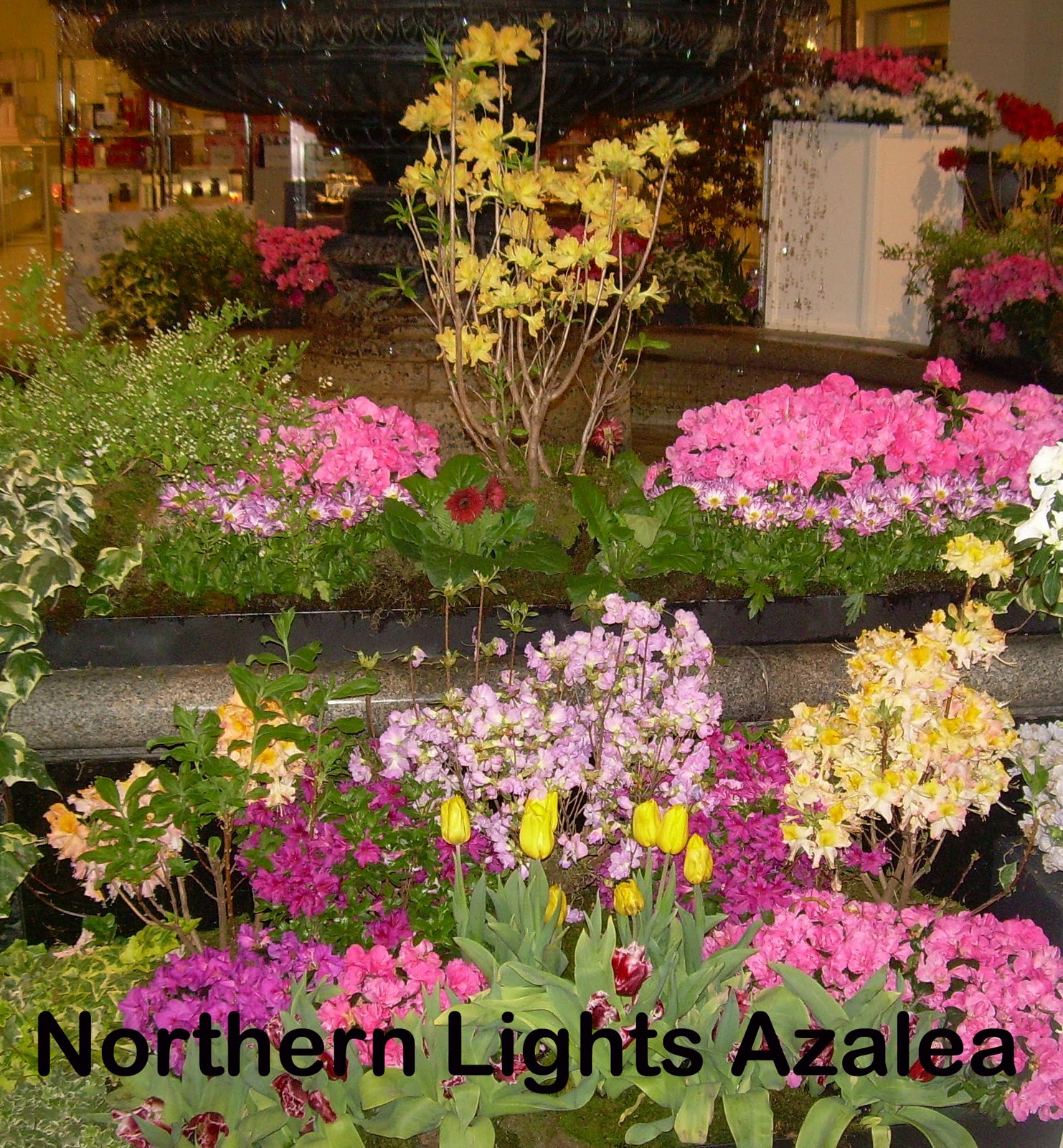
The shrub at the center top of this picture is a variety of azalea called "Northern Lights." What is unique about this shrub, and what makes it a great azalea for our climate, is the fact that it is deciduous, unlike other azaleas and their cousins rhododendrons, that are evergreen. Why does this matter? Because these plants go dormant and are not subject to drying out in our winters. They are not as floriferous as the evergreen ones but I suppose, like lots of things in life, it's a trade off.


The Macy's designers must have had fun putting together these displays. It reminds us that we should have fun in our gardens. Add things that are whimsical or create an unusual juxtaposition, whether it's a fun plant or piece of statuary or even an old bike with the baskets planted up with annuals. Especially this year we could all use a little chuckle and what better place than in our garden.

Sunday, March 29, 2009

Snow in March

What a shock to the system to wake up this morning to a snow frosted landscape. No working in the garden today. For deciduous trees that have not yet leafed out, this bit of heavy, wet snow is usually not a disaster. Down the street from me several trees have branches hanging over the street. If they had already leafed out the extra weight of the snow would have been enough to break them. This happened to us a lot in Colorado, where we once had snow the first week of June and sometimes as early as September. We would be out at midnight shaking the snow out of the trees.

Here it is the evergreens that take the brunt of these late snows. My neighbors have arborvitaes as a screen and over the years many branches have broken. Some are hanging over onto my side of the fence. You can take a broom or rake and gently push up on the branches to remove the snow. Where branches have broken you will need to prune them. This will aid the tree in healing over and reduce the opportunity for disease or insect damage later on. You can go to the Cornell University extension web site for a down loadable brochure on pruning to see how to do it properly.

It is also time to cut back your ornamental grasses. They can be cut back to about 6 inches. You might also give some thought about dividing them. They should be divided about every 2-3 years otherwise they die out in the middle and begin to look like a donut. Many perennials have this tendency if not divided frequently. It is actually a survival mechanism. As the middle dies and begins to decompose it provides needed nutrients to the remaining part of the plant. However, since I know you are very diligent gardeners and fertilize with a well balanced fertilizer every year and otherwise take good care of your gardens, it is an un-necessary task for the plant to do this and plants with holes in the middle are unsightly in the garden. So transplant regularly, (spring is great time to do this), and if you run out of room, find a friend who would like them or donate them to Habitat for Humanity.

And speaking of grasses, this year’s Plant of the Year, as selected by the Perennial Plant Association, is the Hakonechloa “Aureola,” otherwise known as Japanese Forest grass. I guess we don’t often think of grasses as being a perennial, but really they are and the PPA is to be commended for selecting a grass as this year’s Plant of the Year as they have become so popular in recent years. I would have thought that the Plant of the Year might have been a miscanthus, one of my favorite grasses, but the Hakonechloa does have a lot going for it. This grass is hardy in zones 5-8 (we are zone 5) and in our climate does well in partial sun and moist, rich soil. Its leaves are gold with green stripes and will lighten up the darker corners of any garden. It would also look good in a container, with some colorful coleus. It is also deer resistant, which is a definite benefit where we live. You can also go to the Perennial Plant Association web site to learn more about this plant and the PPA.

Wednesday, March 18, 2009

Clematis

Clematis are a great group of flowering vines that are adaptable to many situations. They are usually sold as “sun” perennials, but in fact there are many varieties that tolerate some amounts of shade. There are low growing “shrub” type clematis, clematis that bloom early spring, in the summer and several varieties that bloom in the fall. Most clematis have large, even huge, blooms and some with smaller, more dainty, bell-shaped blooms. Clearly, there is a clematis out there with your name on it.

What throws people off is how to prune it. Most plants are pretty forgiving with how we prune them, the worst that will happen is that you will accidently prune off this year’s buds and you won’t get any flowers for a year. So don’t be nervous… just follow these simple instructions:
Clematis can be divided into three types of plants: those that bloom in the spring, those that bloom in the summer/early fall and those that bloom twice, once in early summer and again in late summer (truth be told I have never had one of my twice blooming plants actually bloom the second time).

Group 1 plants bloom on old wood and should be pruned only after they have flowered for the year. These plants bloom early in the spring. Remove all the dead and weak stems immediately after flowering.
Group2 plants bloom on new and old wood so they bloom both in the early summer and then later on in the summer (maybe). Watch for swelling buds and carefully remove all dead stems above the swelling buds.
Group 3 clematis flowers only on new growth. These are the plants that flower in the early summer. These types of clematis can be pruned hard in February or March.

Here are a few other facts about clematis care:
Clematis prefer cool roots. Dig the hole about 2 feet deep and amend with organic matter. Set the clematis with the crown of the plant about 1 inch below the top of the hole. Back fill with the amended soil and water in thoroughly.
Clematis stems are very brittle. Tie the clematis to the trellis or what ever you want it to grow up and be sure to protect the base of the plant with screening material to prevent animals from damaging the stems.
Apply a layer of mulch over the winter months.

Here's another interesting thought when selecting clematis: you can plant several varieties together as shown in the picture on the right. You can select plants that bloom at the same time but in different colors or you can plant ones that bloom at different times so you always have something blooming. If you want to learn more about clematis, visit the greenhouse staff at Countryside.

Here are some varieties to try for shadier areas:

Alabast: Creamy white 5-6” flowers. Blooms May, June and August
Clair de Lune: 6-7” white blooms that turn to pale lavender. Blooms June, July and late August.
Elsa Spath- Rich lavender blooms, free flowering
Nelly Moser- pale pink with a red bar down the middle, blooms June and September
Lemon Chiffon- pale yellow cream
Viticella varieties: smaller 4-5” flowers, blooms profusely in July and August

Friday, March 13, 2009

Well, this past weekend would not have been a good one to spend out in the garden, but better weather will be here soon! Before things really get going, there are a few chores to be done prior to plants coming out of dormancy and that is pruning. Early spring is a great time to prune because the trees and shrubs have not leafed out and you can still see the branches and most plants heal more quickly in the spring than they do at other times of the year.

We prune for a variety of reasons. Pruning helps maintain the health of the plant. You can begin to control and train the growth of young trees and shrubs so that more drastic pruning doesn’t have to be done later. We also prune to rejuvenate shrubs, but sometimes replacement is the best option in these cases. Trees are a huge investment and add value to our homes, so it is worth spending the time to take care of them properly.

Shrubs: If you are rejuvenating a shrub do not prune more than of the plant during any one growing season. In most instances you will just be removing dead canes or giving a light shaping. In the early spring you can prune the summer blooming spireas, Rose of Sharon, dogwoods (those with colorful bark), privets, potentilla, St. John’s wort and snowberry. You could also prune the buddleia’s, caryopteris, and Russian sage, but here in our part of the country these tend to die back to the ground. Later in the early summer you can prune or shape the spring blooming shrubs such as lilac, rhodendrons, azaleas, and spring blooming spireas.

Trees: If you have mature trees it is probably best to call in a professional. They should send out a certified arborist to do the initial examination of the trees in question. They have the right equipment and experience to do the job right. There is a great pamphlet on the Cornell University web site called "An Illustrated Guide to Pruning Ornamental Trees and Shrubs". They also have information on pruning fruit trees for maximum performance. Pruning fruit trees is definitely a science.

Roses: I always wait until my roses start to bud out before I prune. This way I know exactly what winter damage has occurred. I prune down to the first outward facing bud break. This encourages the growth away from the middle of the plant. You really want to keep the middles as free from branches and leaves as possible. This way light can get all the way down to the lower branches and give the plant the greatest opportunity for photosynthesis as possible. This will lead to greater flower production and is better for overall plant health.

One thing that is really important when pruning is using the proper tools and having them well maintained. At Countryside, the greenhouse staff all use Felco pruners. The great thing about Felco pruners is the blades are replaceable. They are made from high quality steel so they maintain their edge longer and it is worth getting them sharpened. We totally abuse our pruners, cutting wire and plastic and all sorts of things we shouldn’t. Last year K.C.’s husband Duane sharpened all our pruners and that edge lasted all summer. If your budget can’t stand the Felco’s, Corona tools has several pruners that come close to the Felco’s and are not as expensive. Also the Corona tool website has two downloadable guides to pruning so check those out at http://www.coronaclipper.com/. (Lucky thing I always check these links. The first time I typed this in from memory I thought it was just "corona," which naturally took me to the Corona beer site.)

I was going to also cover pruning clematis but that is whole blog in itself so I will cover that next time.